


















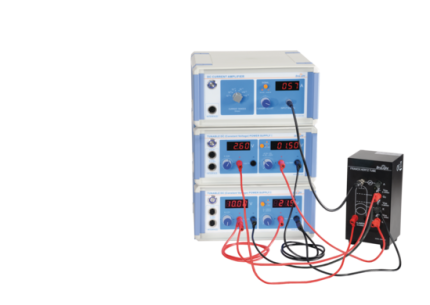
Franck-Hertz System
How It Works
Electrons are accelerated by applying a known potential between two grids inside the argon tube. When an electron has sufficient kinetic energy to excite one of argon’s outer orbital electrons and has an inelastic collision with an argon atom, the electron loses a specific amount of kinetic energy. This loss of electron kinetic energy causes a decrease in the electron current in the argon tube. Within a very short time, the excited argon electron will fall from the excited state back into the ground state level, emitting energy in the form of photons. As the accelerating voltage is increased, the electrons undergo multiple collisions and the excitation energy of the argon atom can be determined by the differences between the accelerating voltages that cause a decrease in the current. Planck‘s Constant can be determined.

G1310-68730 Preventive Maintenance Kit
Preventive Maintenance Kit for Isocratic and Quaternary Pump (G1310A/G1311A). Includes piston seal, PTFE frits, 2 seal caps
Specifications:
| Application Compatibility |
|
| Module Compatibility |
|
| System Compatibility |
|
| UNSPSC Code |
|
| Use With Instrument |
|