








Filter by brand










Analog Hot plate stirrer
Standard Analog Hotplate
- Plate Size(mm) : 260×260mm Plate-type Material Body Powder Coated Aluminum Powder Coated steel Plate Ceramic Coated Aluminum (Chemical / Acid Resistance, Easy to Clean) Temp. Range & Uniformity Max. 380℃Temp., High Uniformity : Difference 10% less Heating Power/Consumption: 1.2 kW





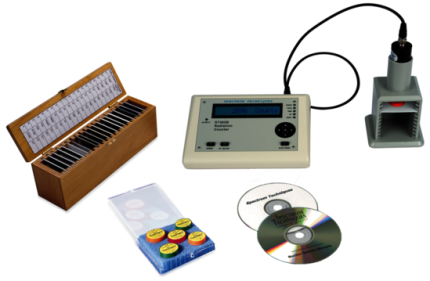
Intermediate Nuclear Laboratory System (Win Mac)
Features
- Preset Timing and Counting Intervals: (in seconds) 1-9, 10-90, 100-900, 1K-9K, 10K-90K, 100K- 900K. Intervals are selected using the Preset switch.
- Digital Display: A bright 6-decade digital readout uses extra-large LEDs for clear readout in most ambient light conditions.
- Built-in Power Supply: 0 to 1200 volts for the G-M Probe.
- USB and serial interface to Mac and PC
What's Included
- 1x Radiation Counter (SN-7907)
- 1x G-M Probe with Sample Holder (SN-7970A)
- 1x USB Cable
- 20x Absorbers (Qty. 20) (SN-8111A)
- 5x Radioactive Sources (set of 5) (SN-7972A)
- 1x Two CDs with installation instructions and nuclear science experiments
Franck-Hertz System
How It Works
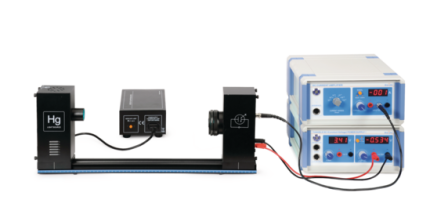
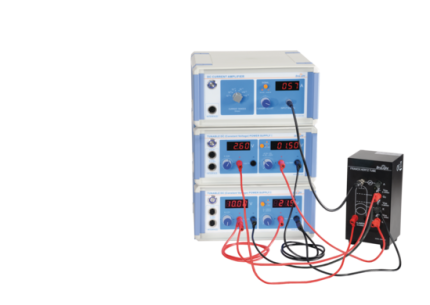
Electrons are accelerated by applying a known potential between two grids inside the argon tube. When an electron has sufficient kinetic energy to excite one of argon’s outer orbital electrons and has an inelastic collision with an argon atom, the electron loses a specific amount of kinetic energy. This loss of electron kinetic energy causes a decrease in the electron current in the argon tube. Within a very short time, the excited argon electron will fall from the excited state back into the ground state level, emitting energy in the form of photons. As the accelerating voltage is increased, the electrons undergo multiple collisions and the excitation energy of the argon atom can be determined by the differences between the accelerating voltages that cause a decrease in the current. Planck‘s Constant can be determined.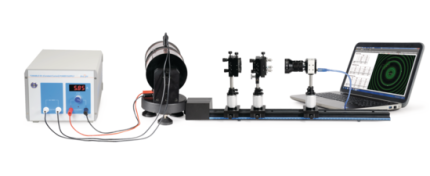
Zeeman Effect
Product Summary
In this experiment, the student observes the interference pattern from a Fabry-Perot interferometer that results from the 546.1 nm spectral line of a mercury lamp immersed in a uniform magnetic field. The magnetic field is varied from zero to nearly 1 Tesla.
Initially, the light is viewed along an axis perpendicular to the magnetic field axis. A polarizer is used to show the three lines due to light that is polarized parallel to the field axis and to show the six lines that are polarized perpendicular to the field axis. The pattern may also be viewed along the field axis where the light is circularly polarized.
Finally, the pattern that is polarized perpendicular to the field axis is used to calculate the Bohr magneton. All atomic magnetic moments are integral or half-integral multiples of the Bohr magneton.