








Filter by brand







Flame Photometer
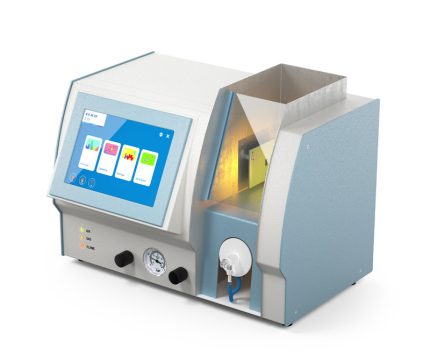
SALIENT FEATURES
Calibration curve programmability can be
done using a maximum of 20 standards in
the range of interest of the user, data
processing through optional curve fitting
techniques like segmental and quadratic.
Analysis made much more simpler
because of the multiple calibration curves
saving facility.
Optional PC compatibility with USB
Interface.
Saving Data and Retrieval of Standards &
Samples.
Zeeman Effect
Product Summary
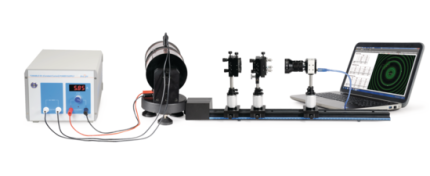
In this experiment, the student observes the interference pattern from a Fabry-Perot interferometer that results from the 546.1 nm spectral line of a mercury lamp immersed in a uniform magnetic field. The magnetic field is varied from zero to nearly 1 Tesla.
Initially, the light is viewed along an axis perpendicular to the magnetic field axis. A polarizer is used to show the three lines due to light that is polarized parallel to the field axis and to show the six lines that are polarized perpendicular to the field axis. The pattern may also be viewed along the field axis where the light is circularly polarized.
Finally, the pattern that is polarized perpendicular to the field axis is used to calculate the Bohr magneton. All atomic magnetic moments are integral or half-integral multiples of the Bohr magneton.
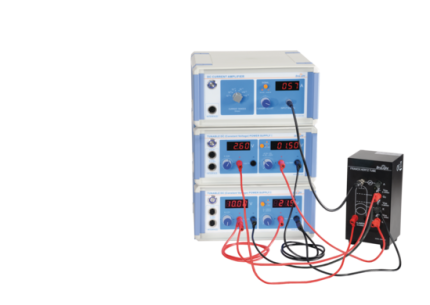
Franck-Hertz System
How It Works
Electrons are accelerated by applying a known potential between two grids inside the argon tube. When an electron has sufficient kinetic energy to excite one of argon’s outer orbital electrons and has an inelastic collision with an argon atom, the electron loses a specific amount of kinetic energy. This loss of electron kinetic energy causes a decrease in the electron current in the argon tube. Within a very short time, the excited argon electron will fall from the excited state back into the ground state level, emitting energy in the form of photons. As the accelerating voltage is increased, the electrons undergo multiple collisions and the excitation energy of the argon atom can be determined by the differences between the accelerating voltages that cause a decrease in the current. Planck‘s Constant can be determined.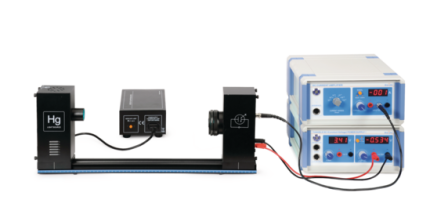
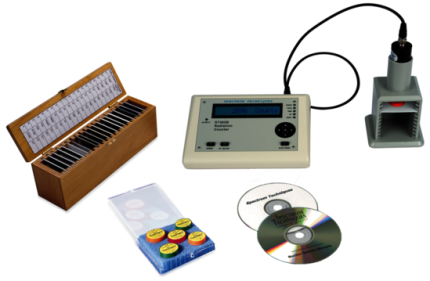
Intermediate Nuclear Laboratory System (Win Mac)
Features
- Preset Timing and Counting Intervals: (in seconds) 1-9, 10-90, 100-900, 1K-9K, 10K-90K, 100K- 900K. Intervals are selected using the Preset switch.
- Digital Display: A bright 6-decade digital readout uses extra-large LEDs for clear readout in most ambient light conditions.
- Built-in Power Supply: 0 to 1200 volts for the G-M Probe.
- USB and serial interface to Mac and PC
What's Included
- 1x Radiation Counter (SN-7907)
- 1x G-M Probe with Sample Holder (SN-7970A)
- 1x USB Cable
- 20x Absorbers (Qty. 20) (SN-8111A)
- 5x Radioactive Sources (set of 5) (SN-7972A)
- 1x Two CDs with installation instructions and nuclear science experiments



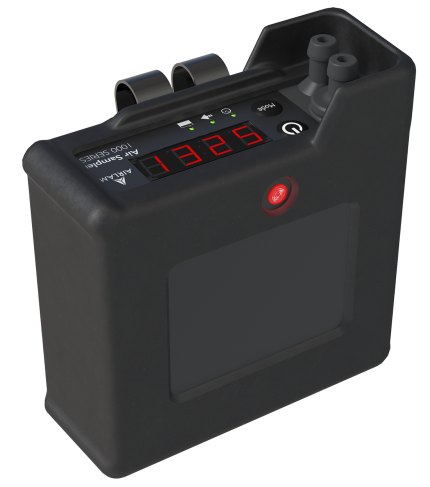
Air Sampler 1000 Series (1000-3000 ml/min)
Small in size, simple to use and easy to operate, the Particles Plus® Air Sampler
1000 Series is ideal for personal sampling applications. Only weighing 0.70 lbs which
provides a flow range between 1000 - 3000 ml/min.
The 1000 Series allows for constant flow correction even with changes in ambient
temperature and barometric pressure through our ultra-quiet rotary vane vacuum
pump technology. The easy to read LED display provides accumulated sampling
volume and a battery conservation mode after 30 seconds of idle use allowing for
over 30+ hours of continuous sampling. The power switch allows for easy operation
including Continuous Sampling, Volume Reset, and Battery Conservation Mode, with
the push of a button.

2301P and 2501P Remote Airborne Particle Counters 0.1 CFM (2.83 LPM)
The 2301P and 2501P particle counters provide a range of particle size measurement
from 0.3 to 25.0 μm at 0.1 CFM (2.83 LPM) flow. These sensors allow for efficient
particle counting with high accuracy and resolution that meet or exceed ISO 21501-4
and JIS B9921 for the calibration of a particle counter.
These units are equipped with an internal pump and manifold and do not require an
external vacuum source. Integration into a building automation or facility monitoring
system is easy via standard MODBUS RS-485 communication.